

Comparison Between Dual-Machine Conversion and Traditional DMA & Features and Advantages of Dual-Machine Conversion
Technical Background: From DMA Golden Age to Comprehensive Crackdown by VTD/IOMMU
In the history of game anti-cheat technology, traditional DMA hardware cheating once enjoyed a years-long "golden age" due to its "absolute invisibility at the hardware layer". By reading physical memory directly through the PCIe interface, bypassing the CPU and operating system, it rendered all software-based anti-cheat measures ineffective. However, this situation came to a complete end in 2026.
On May 22, 2026, Riot Games pushed a landmark Vanguard anti-cheat update for Valorant. Instead of making software-level patches, this update directly targeted the underlying hardware by mandating IOMMU (Intel VT-d/AMD-Vi) hardware virtualization detection, fundamentally blocking illegal memory access channels for DMA devices. After the update, thousands of cheaters suffered unprecedented losses: their game accounts were permanently banned, their expensive DMA cards worth tens of thousands of yuan instantly became useless "high-end paperweights", and some devices even had their firmware remotely damaged by anti-cheat systems, turning into complete e-waste.
This was not an isolated measure by a single game, but the beginning of an industry-wide anti-cheat technology upgrade. Just two weeks later, data from Tencent's Delta Force showed that in the first week of June 2026, the system intercepted 11,778 DMA cheating attempts in real time and banned 33,193 illegal device machine codes simultaneously. This means that once a device is marked as a cheating tool, it can never log into the game again, even with a brand new account.
VTD/IOMMU: The Core Technology That Ended the DMA Era
The
reason why VTD (Virtualization Technology for Directed I/O) became the "terminator" of DMA cheating lies in its implementation of hardware-level memory access isolation through the IOMMU (Input/Output Memory Management Unit). When VTD is forcibly enabled, the entire system's memory access rules undergo a fundamental change:
· All DMA requests from PCIe devices must undergo strict permission verification at the virtualization layer before execution
· Each device is assigned to an independent security domain and can only access pre-authorized specific memory regions
· Any unauthorized memory access request is directly intercepted by the hardware and returns meaningless garbage data
· The system records all DMA access exceptions in detail, which become the core basis for anti-cheat systems to identify cheating
I. Comprehensive Comparison Between Dual-Machine Conversion and Traditional DMA
Faced with the impenetrable barrier built by VTD/IOMMU, traditional DMA cheating solutions have completely lost their living space. Against this technical background, Dual-Machine Conversion (also known as dual-machine architecture or boardless DMA) emerged as a brand new technical route and became the most mainstream alternative in the VTD era. To clearly demonstrate the differences between the two technical routes, we have conducted a comprehensive comparison across multiple core dimensions including detection evasion capability, cost, and security:
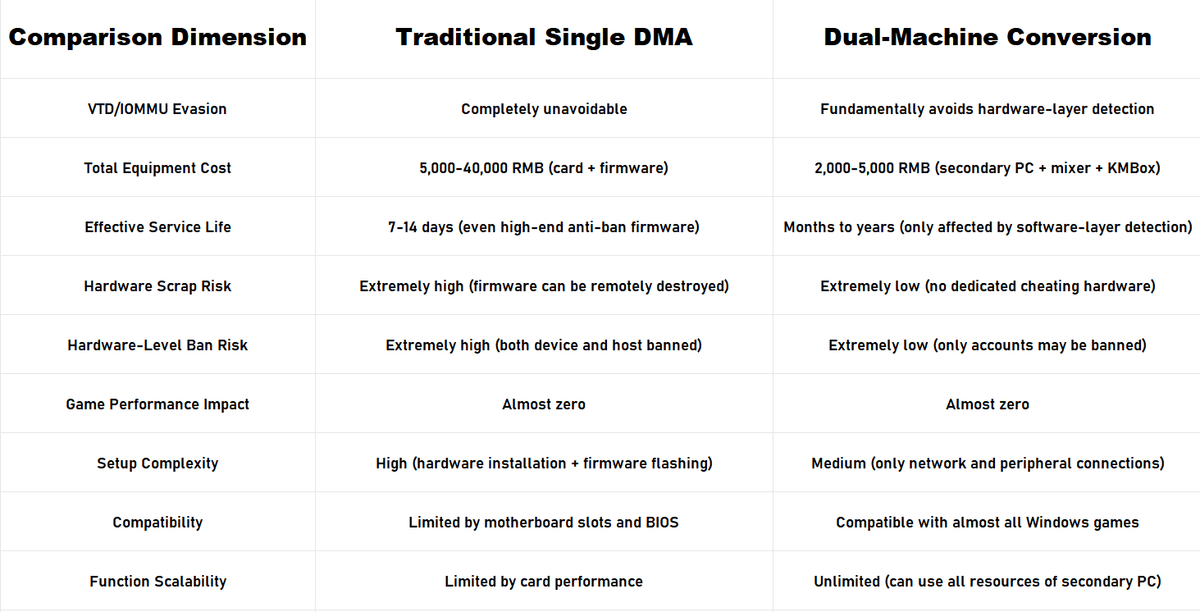
As can be clearly seen from the comparison table, the Dual-Machine Conversion solution comprehensively outperforms the traditional DMA solution in almost all key dimensions, especially in terms of detection evasion capability and long-term usage cost, showing overwhelming advantages.
II. Features, Advantages and Limitations of Dual-Machine Conversion
2.1 Core Technical Principle: New Possibilities Brought by Physical Isolation
The fundamental reason why the Dual-Mach
ine Conversion solution can break through the VTD/IOMMU blockade is that it completely abandons the traditional DMA technical route of "hardware direct memory reading" and adopts a brand new architecture of complete physical isolation + software-layer data transmission. This architecture completely separates the two functions of game running and cheating computing onto two independent computers, physically cutting off the direct connection between cheating programs and the game host:
· This computer is only responsible for running the Windows system and the game itself. No cheating-related software, drivers, or background processes are installed. From both appearance and system levels, it is indistinguishable from a regular player's computer
· All cheating logic, data processing, and interface rendering are completed on this computer. It acts as an independent "cheating computing server" with no software-level connection to the game host
· The two computers are connected via Gigabit or 10 Gigabit Ethernet. All game data and cheating instructions are transmitted at high speed within this closed local area network and never pass through the public internet
· Dedicated hardware controllers like KMBox connect the host to the keyboard and mouse. The secondary PC sends simulated hardware input signals to the host through this controller to implement functions like aimbot and recoil control
· An HDMI video mixer overlays the cheating interfaces rendered by the secondary PC, such as ESP and aimbot crosshairs, onto the host's game screen in real time. What the player sees is the complete fused image
2.2 Core Mechanism for Evading VTD/IOMMU Detection
The core advantage of the Dual-Machine Convers
ion solution lies in its design that does not rely on PCIe hardware direct memory reading at all, which allows it to fundamentally escape the detection range of VTD/IOMMU. Specifically, it achieves perfect evasion of hardware-layer detection through the following aspects:
1. No PCIe expansion cards are inserted into the host, so no PCIe-based detection mechanisms are triggered, physically eliminating the possibility of being identified as a suspicious device by VTD/IOMMU
2. Game memory data is obtained through legitimate system API calls. All memory access follows the normal operating system permission scheduling and verification processes and will not be intercepted or marked as abnormal by the IOMMU
3. There are no traces of cheating software on the host — no DLL injection, no memory hooks, no abnormal processes. Even the most in-depth system scan cannot find any clues of cheating
4. All data and instructions are transmitted within the local area network and never exposed to the public internet, so they will not be detected by network-layer anti-cheat mechanisms
2.3 Detailed Core Advantages
In addition to the core advantage of perfectly evading VTD/IOMMU detection, the Dual-Machine Conversion solution also shows advantages that traditional DMA cannot match in multiple aspects such as cost, security, and compatibility:
1. Significantly Improved Cost-Benefit Ratio
Traditional DMA solutions not only have high initial investment In addition, the long-term maintenance expenses are staggering. On average, thousands of yuan need to be spent every 10 days to update the firmware, otherwise it will be detected by anti-cheat systems. In contrast, the initial investment of the Dual-Machine Conversion solution is only 1/2 to 1/10 of traditional DMA, and there is no need for frequent expensive firmware updates. Only minor adjustments are needed when the game releases major version updates, making its long-term usage cost advantage extremely obvious.
2. Extremely High Security and Reusability
Once a traditional DMA solution is detected, not only the account will be banned, but the DMA device itself and even the host will be permanently blacklisted, causing irreversible hardware losses. The Dual-Machine Conversion solution completely eliminates this problem: even if a game account is banned, the host, secondary PC, and all peripherals remain unaffected and can continue to be used with other accounts. Additionally, users can disconnect the secondary PC at any time, and the host immediately returns to a clean, normal state without leaving any cheating traces.
3. Excellent Stability and Compatibility
The Dual-Machine Conversion solution is not affected by VTD/IOMMU version updates or Windows system patches, and will not suddenly fail due to system upgrades. At the same time, it adopts a universal architecture design that is compatible with almost all Windows-based games, eliminating the need to develop bypass solutions for each individual game. Furthermore, leveraging the powerful computing capabilities of the secondary PC, users can easily expand complex functions such as team data sharing and multi-device collaborative control, which are impossible for traditional DMA solutions limited by hardware performance.
Conclusion
Looking back at the development history of game anti-cheat technology, we can clearly see a trajectory of escalating technical confrontation. From the initial software-layer anti-cheat, to the rise of traditional DMA hardware cheating, and now to the comprehensive popularization of VTD/IOMMU hardware-level protection, every technological innovation is redefining the boundaries between offense and defense.
Against the industry background of mandatory VTD/IOMMU popularization, traditional single DMA solutions have completely lost their living space. They not only have extremely high economic risks but also technically cannot keep up with the update pace of anti-cheat systems, becoming an outdated technology with high investment, high risk, and low return. In contrast, the Dual-Machine Conversion solution, with its innovative physical isolation architecture, fundamentally avoids hardware-layer detection and shows significant technical advantages and cost-benefit ratios in the current stage, becoming the most mainstream alternative in the market.